

Django Mindoff
Architectural framework to build production-ready Django REST APIs faster with less boilerplate.

Purpose
Every Django API project starts the same way: blank file, no structure, and a clock ticking. Setup is tedious, standards drift between developers, and once the data gets large, Django's serializers quietly become the bottleneck. Django Mindoff was built to fix that — a fully managed framework that handles scaffolding, routing, validation, queuing, and bulk data operations out of the box, so the work that actually matters can start on day one.
- Built
- Form
- python package
- State
- active
Brief
Django Mindoff is an architectural framework for building production-ready Django REST APIs. It handles the structure, mechanics, and operational plumbing of API development so developers can go straight to writing business logic. It sits on top of Django and Django REST Framework, with Polars as the data layer for large-scale reads and writes.
The problem
Building Django APIs for a living means starting from scratch more often than it should. There is no enforced structure in a fresh Django project. Every team does it differently. Every AI-assisted scaffold comes out slightly different from the last one. Over time, projects diverge, and divergence costs.
1. Throughput
Django REST Framework's serializers are reliable and well-tested for most workloads. But they process row by row. Feed them a hundred thousand records and the wall-clock time climbs, the memory climbs, and the only real fix is to stop using them for that job. There was no clean drop-in replacement inside the Django ecosystem.
2. Overhead
Queue-backed processing, rate limiting, request lifecycle management: all assembled from separate packages, each with its own config surface. Getting that baseline right is real work, and it has nothing to do with the feature you actually came to build.
Boilerplate is the tax you pay before the real work begins. Django Mindoff was built to lower that tax.
Approach
Build on Django, not against it
FastAPI and Pydantic were an obvious reference point. But the developers this was built for already know Django's ORM. They trust it. Switching the foundation to gain speed while losing familiarity is a trade-off that rarely pays off for teams doing real product work.
The decision was to stay inside the Django and DRF ecosystem and extend it, not replace it. That choice has a practical upside: both Django and DRF are actively maintained, security-patched, and not going anywhere. Anything built on top inherits that stability. Django Mindoff is committed to tracking their releases for the long term.
Replace serializers with Polars for bulk operations
Polars already had the benchmark results. It has a Rust backend, it handles DataFrames and LazyFrames natively, and building something comparable from scratch would have been a project in itself with no guarantee of matching its performance or reliability.
The goal was to make bulk validation and writes feel like a single step: pass a model_frame (a DataFrame or LazyFrame) to create or update, and Django Mindoff validates it against the Django model in a vectorized, loop-free pipeline before writing directly to the table. The same path works in reverse: pass in a queryset, get back a DataFrame with pagination and streaming already handled.
CLI scaffolding with enforced structure
Rather than leaving structure to convention, Django Mindoff ships a CLI that generates the same scaffold every time: manage.py, mindoff.py, config/, apps/. Apps and APIs are wired into routing and INSTALLED_APPS automatically on creation. Any developer picking up a Django Mindoff project sees a familiar layout regardless of who initialized it.
This also closes the AI agent drift problem. Django Mindoff ships with agent instructions for AI coding assistants, so any developer using one gets Django Mindoff-aware output without re-explaining the architecture at the start of every session. Consistent structure, consistent generation, lower token cost. 🎯
Queue mode in one line
Long-running processes that exceed request timeouts are a quiet source of production pain. The typical solution is to configure a queue, wire up a worker, handle status tracking, build cancellation, manage retries. It works, but it is infrastructure work before the feature is done.
In Django Mindoff, the change is one field in the API definition:
process_mode = "queue"That is it. Django Mindoff takes over the orchestration: TTL, auto-expiration, status tracking, progress updates, cancellation, retries. The developer doesn't touch any of it.

Key challenges
Replacing DRF serializers was the hardest problem in the project. Serializers are trusted for good reason: years of production use, clear error messages, consistent behavior at the edge cases. Building a vectorized alternative that matched that reliability while processing data as DataFrames required careful work on the validation pipeline. The goal was not to trade correctness for speed. Vectorized validation had to produce the same quality of feedback as the row-by-row approach. That bar took time to reach.
The second challenge was the surface area of the API definition. Complex workflows — validation, queuing, rate limiting, access control — all had to be configurable from a single definition file without leaking implementation details into the developer's code. The instinct in framework design is to add knobs. The constraint here was the opposite: keep the surface minimal enough that a developer doesn't need to remember more than a handful of fields. That balance is harder than it sounds.
What was built
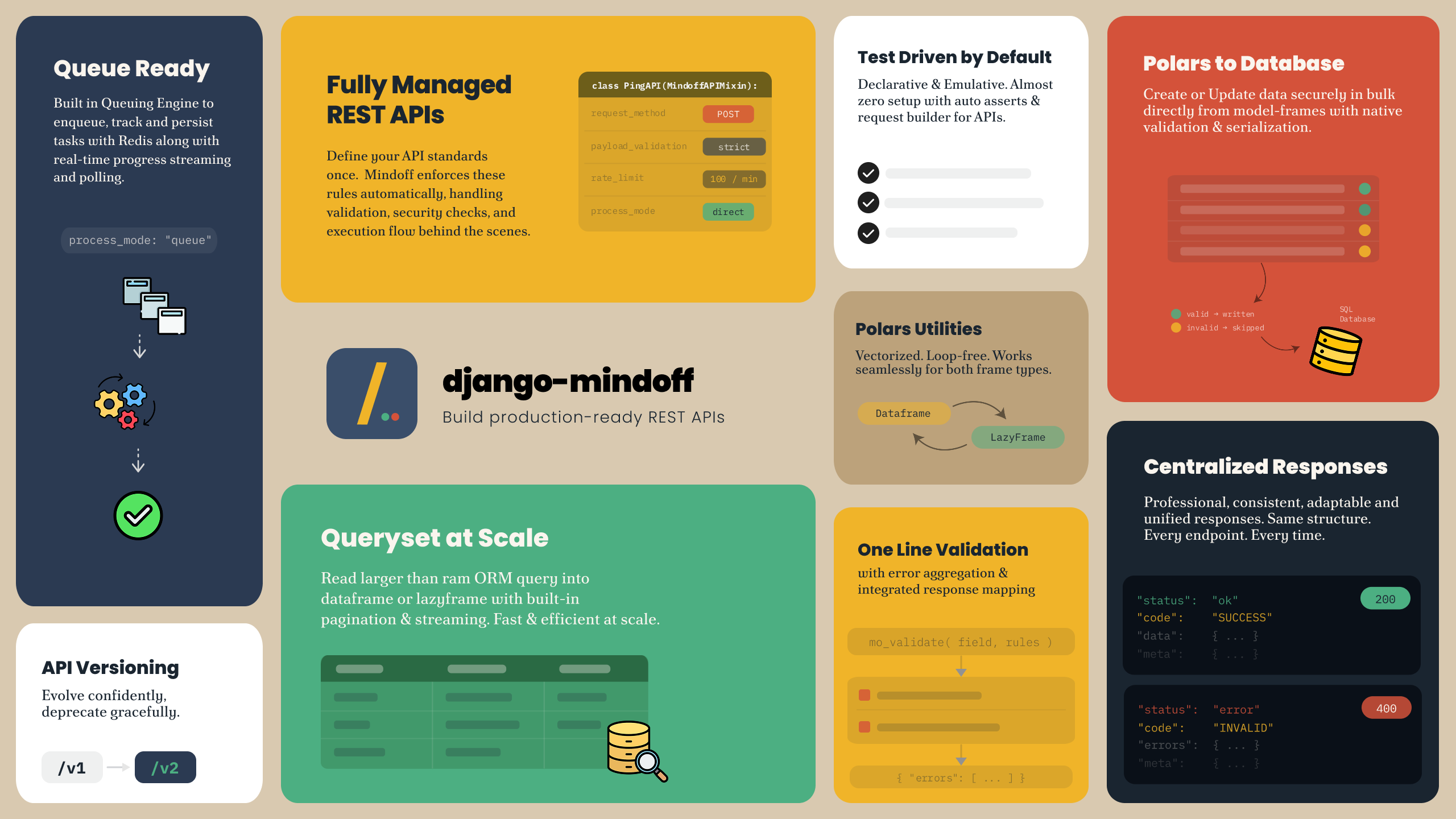
- CLI toolkit:
init,create,delete, andnukecommands for project and app lifecycle management - Managed API definitions: Single-file config covering request method, access control, payload rules, rate limits, and execution mode
- Versioned routing: Auto-registered URL structure that keeps API versions clean and backward-compatible
- Queue-backed processing:
process_mode="queue"triggers full orchestration with TTL, cancellation, retries, and status endpoints - Vectorized validation and bulk writes:
model_frameaccepts a DataFrame or LazyFrame, validates against the Django model, and writes to the table in one step - Queryset-to-DataFrame conversion: Any Django queryset converts to a DataFrame or LazyFrame with pagination and streaming support
- Polars utilities: Checks, conversions, and transformations that run natively across both DataFrame and LazyFrame
- Declarative test mixins: API tests with minimal setup, focused on behavior rather than boilerplate request construction
- Agent instructions: Bundled instructions for AI coding assistants to build, edit, and extend Django Mindoff APIs consistently
Outcome
Django Mindoff is live on PyPI and running in production across major commercial products.
The project is maintained with a long-term support commitment: updates track Django, DRF, and Polars releases as they ship. Community contributions are open, with a detailed contribution guide for anyone who wants to get involved.
Full documentation: django.mindoff.work/latest-release.
Contribution guide: django.mindoff.work/latest-release/community/contribution-guide.
Learnings
The most durable decision in the project was staying inside the Django ecosystem. Frameworks that extend what developers already trust get adopted. Frameworks that ask teams to rethink their foundation rarely do. The module-based design also proved itself: issues stay localized, fixes propagate from one place, and the core processing stays decoupled from the surface. That architecture was a deliberate bet. It paid off.