

A Minimalist's Guide to Engineered Wood
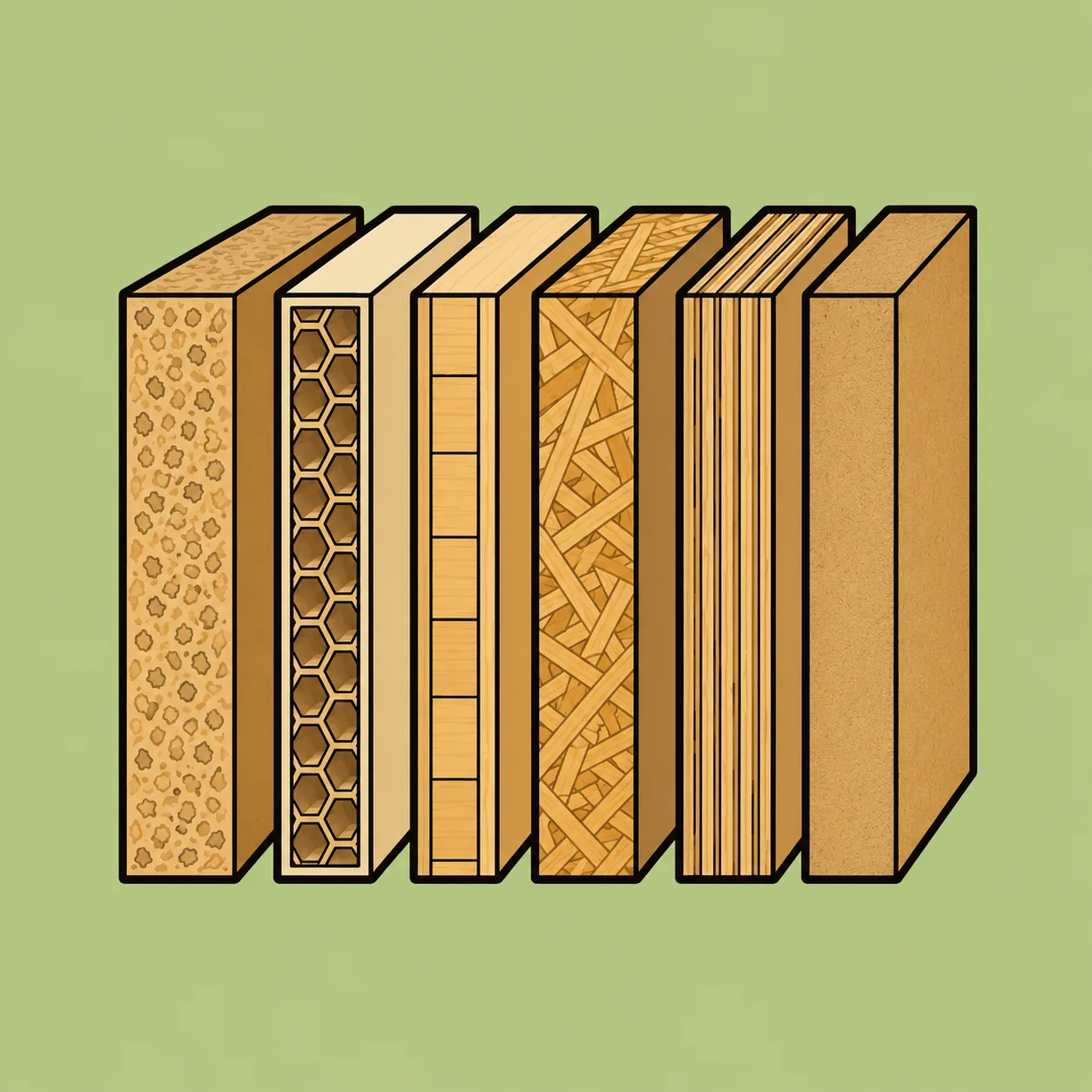
I used plywood for everything. Cabinets, shelves, tabletops, prototypes. It's strong, widely available, and it works. The problem is that "it works" is not the same as "it's the right choice."
The moment that changed my thinking was a prototyping run. I needed flat boards I could paint quickly and move around the workshop. I bought plywood, like always. It did the job, but it was heavy, the edges needed sealing before paint would take, and I spent more time prepping than building. MDF would have been lighter, smoother straight off the sheet, and cheaper for that specific use. I'd been ignoring the better tool because I hadn't thought about the material as a variable.
This guide is the thing I wish I'd read before buying another sheet by default.
1. Plywood: the structural default
Plywood is made from thin wood veneers glued in alternating grain directions. That cross-grain structure is what gives it strength: it resists warping, holds screws tightly, and handles weight without flexing.
Pick this when you're building something that needs to last: cabinets, tables, wall panels, or anything structural. Higher grades (BWP, marine-grade) add moisture resistance for bathrooms or semi-outdoor spaces.
Watch out for internal voids in cheaper sheets. Always check the cross-section before buying. Raw edges need sealing or edge-banding before paint will take cleanly. Low-quality plywood can look fine on the surface and fail at the cuts.
This is still my first pick for anything structural. I just stopped using it for everything else.
2. MDF: for paint and precision
MDF (Medium-Density Fiberboard) is made from fine wood fibers compressed into smooth, dense boards. No grain, no knots, no variation. What you get is a perfectly consistent surface throughout.
Pick this when the finish is what matters: painted cabinet doors, wall paneling, trims, decorative molding, or CNC-routed work. MDF takes paint beautifully once you seal the edges with primer or PVA glue first.
Watch out for moisture. Any real exposure causes swelling, and it's not reversible. It's also not structural, so don't use it for load-bearing builds. Cutting it produces a lot of fine dust, so mask up and clean your workspace.
This is the material I should have used on that prototyping run. Lighter, smoother right out of the sheet, and far easier to work with for anything that's getting painted anyway. The switch would have saved me an hour of prep.
3. HDF: MDF's tougher sibling
HDF (High-Density Fiberboard) is made the same way as MDF but compressed more tightly. The result is denser, harder, and more resistant to daily wear.
Pick this when you need the smooth finish of MDF in a high-traffic area: drawer bottoms, cabinet backs, flooring underlayment, or wall panels that will take knocks. It holds screws better than MDF if you pre-drill.
Watch out for the weight. HDF is heavier than MDF and wears down blades faster. Use sharp bits, pre-drill every screw hole, and expect it to be more tool-intensive than it looks.
4. Particle board: cheap, temporary, and honest about it
Particle board is made from sawdust and resin pressed together. You'll find it hiding inside most flat-pack furniture, usually behind a laminate or veneer surface that makes it look more capable than it is.
Pick this when you need something affordable and non-load-bearing for a short time: temporary shelving, budget wardrobes, low-stakes builds where cost is the only constraint.
Watch out for everything else. It chips, absorbs moisture, and doesn't hold screws reliably. Once it starts to fail, it's not fixable. If you're building something you want to keep, particle board will cost you more in time and replacements than you saved at the store.
A common mistake is buying pre-laminated particle board and assuming the surface coating makes it durable. It protects the look, not the material underneath.
5. Blockboard: for wide spans
Blockboard has a core of softwood strips sandwiched between veneer sheets. That construction gives it stiffness across wide spans without the weight of solid wood or thick plywood.
Pick this when you're building something wide that needs to stay flat: long tabletops, large shelves, interior doors. It resists sagging better than MDF and is lighter than equivalent plywood for the same span.
Watch out for screw grip. It's not as reliable as plywood for fastenings, and internal gaps are possible in lower-quality sheets. Edges need sealing before they're finished.
6. Veneered boards: the look of hardwood, not the price
Veneered boards are engineered sheet material (MDF, plywood, or particle board) with a thin real-wood face. You get authentic grain from teak, walnut, or oak without paying for solid hardwood.
Pick this when the surface is the point: drawer fronts, visible cabinet faces, furniture where grain and warmth matter. The substrate underneath handles structure; the veneer handles aesthetics.
Watch out for the veneer being thin. Over-sanding cuts right through to the substrate. Cuts need scoring or a sharp blade to avoid chipping at the edges. Use matching edge-banding by species or the joints will show.
7. Laminated boards: pre-finished and low-maintenance
Laminated boards are engineered panels with a hard, plastic-like laminate bonded to the surface. Modular kitchens, office furniture, and wardrobes are full of them.
Pick this when you want a surface that's ready to use with no finishing work: kitchen cabinets, wardrobes, surfaces that get wiped down. The laminate resists surface moisture and comes in a wide range of colors and textures.
Watch out for cut edges. The laminate chips without scoring, and once it's damaged it can't be refinished. Edge-banding at every cut edge is not optional.
8. OSB: for structure, not show
OSB (Oriented Strand Board) is made from large wood chips compressed with adhesive. It's a construction material: strong, affordable, and completely unpretentious about what it is.
Pick this when looks don't matter and strength does. Subfloors, wall sheathing, workbenches, garage shelving, utility builds. It's stronger than particle board and handles moisture better than MDF, which makes it genuinely useful for rough or hidden work.
Watch out for the surface. It splinters, doesn't take paint well without prep, and isn't something you'd use anywhere it will be seen.
The two questions that cut through most of this
Before you buy anything, answer these:
- What will this actually do, and for how long?
- Will it ever see moisture?
The first question rules out particle board for anything structural. The second eliminates MDF and particle board from kitchens, bathrooms, and anything near a window.
Defaulting to whatever is available feels efficient in the moment. It rarely is. The wrong material costs time before it ever costs money.
Pick the material for the job. It takes two minutes of thinking upfront and saves hours of working around a choice you made on autopilot.